
Talk before Salesmen 12/1/70
From OCR


Gentlemen, it is a pleasure to meet all of you front line troops. You guys that carry the banner. The guys on t he firing line — you are fired up today, you will be more fired up tomorrow and come Saturday you
should be at the point of pitying the competition. But, you had better not, because
heis absolutely ruthless.
His goal in life is to put us out
of business. Now, we are going to help you keep your guard up
We’ ve got a hot product.
It’s got a concept, it fits all t he
buzz’ words, pl us cr eat es a few of its own. It’s got a price
low enough that you don’t have to give trading stamps
it’s got class.
customer is going to be our customer because we do his job
better – because we make him feel confident with us. personal charm can get you an audience with a prospective
customer, your.-s,u:periorsalesmanshipcangethimtoinstall
But that ain’t gonna be what sells it.
a system, but that’s only the preliminaries •
have got to keep it there. All the personal charm and sales-
manship in the world won’t keep equipment installed if it’s not performing for the customer. The one thing worse than not
making a sale, is making one that you~can’t keep made.
are going to provide you some ground rules, some guidelines
and some absolutes that will maximize the odds
instal led equipment installed.
Gentlemen, you are part of a company that is the world leader in real-time data cap@Ore. The world doesn’t know that yet,
but you guys are gonn% tell ~em. And, you’ re gonna tell ~em with more than buzz wor84 — you’ re gonna tell ~em with installed
equipment. And, we’ re going to install equipment by being able to minimize the time, the complexities, the error and
the cost of data cap@ere.
In 1965, after 85 years of accepting the punched card as the only viable method for high volume media conversion, the
world had the opportunity and. the pleasure to try a different approach. Keyboard to compatible tape. It wasn’t a new concept, but it was the first practical implementation of the coneppt. It had some advantages, but only one significant one, it had an internal memory that permitted operators to move at their own speed, and it had disadvantages, it required change. Pressures like the suddenwaneof newS360 systems which pushed delivery times on KP’s to 12 to 16 months and
zip codes that found no vacant columns on, an 80 column card,
not to gentian the shortage of keypunch operators. The
result was fantastic, overnight a small company in Herkimer,N.Y. had created a new industry, and key tape devices were recorded
as a sure road to success~ All one had. to do was look at the number of installed keypunches and the market of key tape machines was unlimited. By early ’68, key tape systems were appearing like toadstools in a spring rain.
By lat e ’69, to the sorrow of many, it was found that all keypunches were not targets for key tapes and that there was a hell of a lot more to media conversion than keyboards magnetic tape and stylized casework. MDS had delivered, maybe 20K units and then found themselves in a holding action against all the “me-too’s”. .
What is it that gives the keypunch such staying power:
2. 3 •
Is the inertia of existing procedures and people skills. The intrinsic advantages of a unit record.
Most importantly, what has been offered as a replace-
ment is recognizable as only an interim step. And for the guy to change, he has to see a path to where he wants
to be. And where does he want to be?
ON LINE
Why
He wants to get rid of the shell game, obviate the shuffling
of cards and t apes and yaper. I
He wants a more timely reporting of changes in his assets.
The more timely his reporting, the faster he turns his inventory,
He wants to eliminate error. To do this, his entry of data must be interactive with his overall data base.
I said, the user wants to get on line, but, he is not ready
today. Our opportunity is to solve today’s problemtoday, with equipment that can al so put the user on l ine. A system
that will permit an orderly evolution fwom free-standing data stations to true on-line operation. That’s our concept
a concept backed by hardware than can do.
I haven’t had sufficient personal conversation with each of you to know and understand why you joined Cogar Corporation.
If it wasn’t to help build. a great company, then you have the wrong motive. Because that’s what it’s all about. This
company was started without a product or a product concept. Products and product concepts are transient, they live but ashort time. Tolive,acompanymusthavevision,conv~qtion and a willingness to compete. It has to have teamwork and leadership. We are going to provide the leadership and we are going to demand that everyone be part of the team.
A lot of people are expecting big things of us. We’ re not going to disappoint them.
Cogar Picks Treasurer, Retains Law Firm 7/18/69

Cogar Advertisement 4/26/70

Singer Buys $6.5 Million of Cogar Stock 9/19/1970
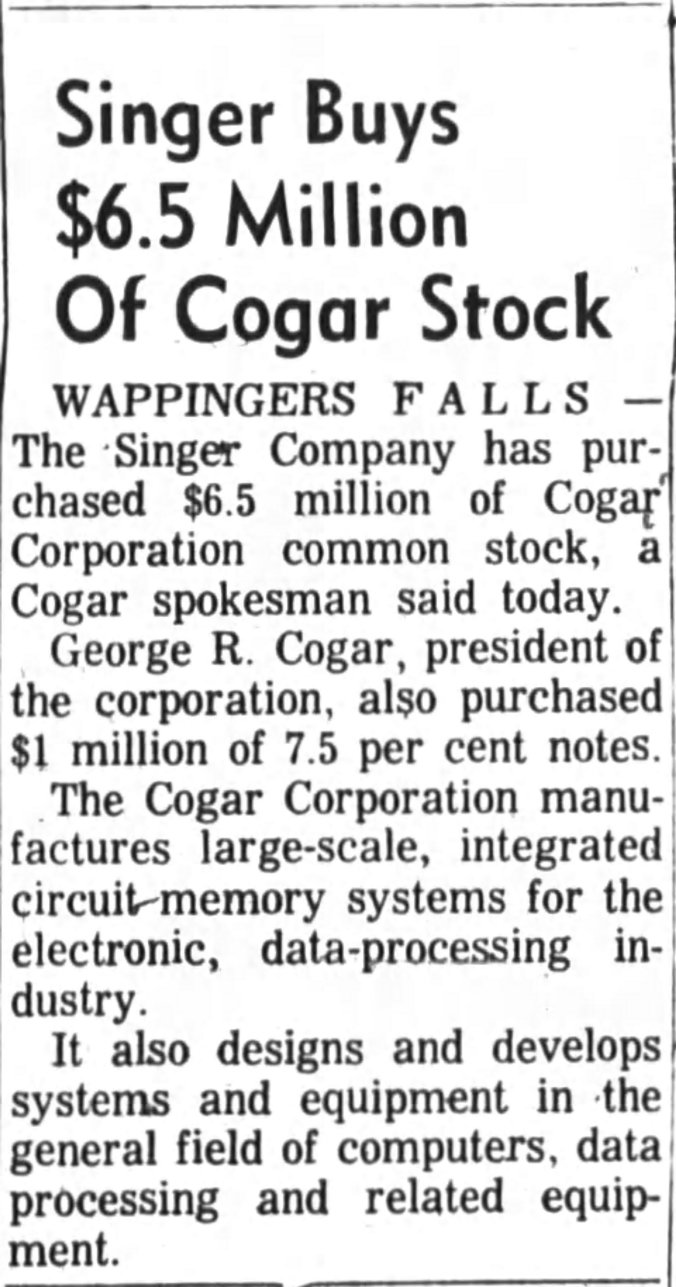
Stockholm Talk


Technology and Market’s for the 70’s
From OCR
Page 1
MEMORIES – TECHNOLOGY AND MARKETS FOR THE 70’S
Technical Judgements: Business Decisions
I would preface my comments with the acknowledgement that forecasts of change must weigh carefully the inertia of opinion.
Memories for computers will represent the largest dollar volume for an identifiable product entity in the electronics industry for the 70’s. Early in the decade, monolithic semiconductors will become the dominant main memory technology representing m~re than half of the new sales by 1975 and constituting the majority of in-use main memory before the close of the decade. Read only memories will be an insignificant percentage of the total memory market, due principally to diminishing cost performance advantage, high tooling and support cost and high potential obsolescence.
There are a number of compelling reasons for this to occur – most significantly:
Semiconductor memories offer raw performance in terms of speed and density which is unachievable in other current technologies.
With sub i00 nanosecond memories now in production and new designs having another order of magnitude increase in speed, now in the laboratory, semiconductor memories constitute an exclusive performance class.
Monolithics, being a homogeneous technology, offers the potential of entirely new system architectures. These new architectures will involve parallelism to a degree where today’s definition of memory and processor will seem nonsensical. Hard implementation of memory hierarchy will provide transparency for all levels of programming. Associative memories will become econonkically feasible and it can be expected that associative concepts will be extended to include synoptics.
These new architectures can be expected to contribute substantially toward the solving of the problem of software economics.
Page 2
Being a process-based technology, monolithics have an intrinsic reliability unachievable by technologies involving a piece part assembly base. Further, where the assembly-based technologies have reached, or are rapidly approaching, a plateau in terms of mechanization and will thus have their manufacturing costs directly tied to labor, monolithics have the’potential for significant increases in densities, yields and packaging innovations.
Viewed from a different perspective, one which encompasses overall computer technologies for the 70’s and beyond, monolithics must become the dominant technology if for no other reason than simply that the rate of expenditures within the industry has become so high that we cannot now afford a transitional technology having a known obsolescence. While the inertia of capital investment and engineering and manufacturing skills will be a pressure to extend the life of magnetic technology into the 70’s, the threat of early competitive impact of systems utilizing magnetics will cause monolithics to prevail.
Even the now promising bubble may burst under the competitive pressure of investment in semiconductor technologies with array densitites approaching one million bits per square inch.
To this date, to a great extent, the’management of our industry could be characterized as a tug of war between the engineer and the marketeer. While this was probably a necessary part of the development period of our industry, it is now a luxury we can no longer afford. We have reached a level of business where we can no longer afford to innovate for the hell of it or to market on a basis solely of~ faster, more exotic device. )
Page 3
With the change to principally a process-based technology, one characterized by very high capital investment and a heavy scientific supporting base, many companies must necessarily re-examine their proprietary posture of what and from whom they buy and what and to whom they sell. To those companies who continue to plan their business solely to maximize value added in the p~oduction of hardware, great trauma lies in store.
Where the engineer, the programmer and the marketeer previously made decisions, they will now provide judgement contributing to a more broadly based business decision. Technologies having reached a plateau that is sufficiently broad to discourage the expenditures necessary to attempt the scaling of the next precipice, efforts will now be concentrated onthe refinement of technologies and broadening of the market base.
Submitted by George R. Cogar President Cougar Corporation Herkimer, New York
IEEE – International Computer Group Conference & Exposition Washington, D. C. – June 16-18, 1970.
The 70’s will see a new era of ent~epreneu~ship. Opportunities wi~ increaae in line with the growth of new technologies.
The important ventures of the 70’s, however, will differ significantly from those of the 5O’s and 60’s, in that the ventures of the 7O’s will sta~ on a larger scale.
New technologies are more complex and will require a broader spectrum of disciplines to form a viable organization with sufficient freedom of choice in the planning of it~ development and growth.
The o~ook of people comprising the knowledge industries ~ expanding beyond the perimeter of their own individual specialities.
They are searching for challenges that will also involve the wtilization and management of new idea~ and new technologies.
Knowledge ~ the new wealth, the new ea~, and the people who are making the greatest contribution to tt~ compound growth are going to in6ist on having a proportionate voice in its direction and u~e.


Cogar 70 Brochure
From doc OCR
Page 1
COGAR 70
The 370*memory. For 360*users.
It’s the first totally monolithic add-on memory for your 2365 requirement. Giving 360 users all the speed and reliability of monolithic memory technology. Without requiring them to move to a new computer system. Or to make any changes in their present software. Cogar 70 is the perfect way to add capacity and improve system performance. Plug-to-plug compatible with System 360 processors using Type 2365 Model 2 memories, it offers new generation technology at substantially less cost than add-on systems employing cores. And it expands to a full megabyte of storage. With further cost savings on each capacity addition. If you’re considering an add-on memory, there are three things you should know about the Cogar 70. It’s more reliable. About half the size of a 2365. And it costs less.
*370 and 360 are IBM designations for its computer systems.
Cogar 70. The best memory system available at the end of a plug.
Page 2
Monolithic technology reduces size, cuts cost …
Because of the miniaturization made possible by LSI technology, a single Cogar 70 can provide all the capacity and performance of four 2365 add-on memories. And because of Cogar’s efficiency in monolithic memory production, it is priced substantially
One Cogar 70 can replace four 2365’s.
below a 2365 with comparable storage capacity. Each Cogar 70 is a complete, self-contained memory system. With all control and timing logic, power supplies and cooling systems, parity error checking and an off-line fault-isolating system built in.
The basic system provides 262K bytes of memory. But it can be expanded to a one-megabyte memory system with plug-in 262K-byte units that enable it to grow with your requirements. Cogar 70 meets or exceeds all performance specifications of the 2365 add-on system. Access time is 425ns. Cycle time is 750ns. Its interface includes the capability of receiving and transmitting all multiplex and simplex signal lines at their proper logic levels. And all power supply control lines. The system takes up less floor space than the 2365 and can be expanded without additional cabinets. Cabinet styling is complementary to most 360 installations.
N..
Page 3
… and adds system reliability.
Basic System Memory The Cogar memory system is organized as two interleaved, independently addressable, even and odd storage modules. Each contains 131K bytes: Each has its own timing and control logic and is addressable by byte. In addition, there is a monolithic storage-protect memory of 128 words by 8 bits. This protects main memory in 128 segments of 2048 bytes in both store and fetch modes. Main memory in the Cogar 70 uses bistable MOS circuits for storage with bipolar support circuits. The storage-protect memory is entirely bipolar.
Fault-isolation control panel A built-in, off-line test system makes Cogar 70 the easiest memory system to maintain. Diagnostic routines quickly locate any component or connector failure that should occur. Field repairs are made simply by replacing the affected card with a new, plug-in memory card. This approach will, in most cases, have the Cogar 70 back in operation soon after the field service representative arrives.
• •
• • • • • • • ▪ • • •
qavvitaa a vovvvvv 1111:11ti I vt000ttotoi:
……..
Page 4
COGAR CORPORATION TECHNOLOGY DIVISION
All Angels Road, Wappingers Falls, N.Y. 12590 (914) 297-4323 Sales offices: Boston, Philadelphia, Dallas, Los Angeles, Munich, JOS Co., Ltd., Tokyo
Specifications
Speed Cycle time: 750ns (400 interleaved) System access time: 425ns maximum Power All DC power is generated internally, controllable from the memory unit or the CPU. Input power to the system is specified below: Voltage: 208/230 VAC Service: 3 phase, 4 wire Frequency: 60 HZ ± 1 HZ Current: 20 amperes maximum Physical Characteristics Dimensions: 48 inches long 30 inches wide 73 inches high Weight: 1100 pounds Environment Temperature: 60° to 90° F Relative humidity: 20 to 80% without condensation
Purchase, lease and maintenance agreements are available on request.
73 inches
H48 inch +—30 inches–I


Cogar 4 photo with description
From doc OCR
Page 1
Heart of the Cogar 4 is a Program cartridge which instructs the machine’s memory. Cogar Corporation in Schuyler, N. Y. produces the Cogar 4, a desk-,op data entry and processor tysteM.

Introduction to Cogar 4 1/18/71
From doc OCR
Page 1
ON THE INTRODUCTION OF THE COGAR 4
Remarks by George R. Cogar, president, Cogar Corporation New York, January 18, 1971
Eighteen months ago, my colleagues and I, at a press conference here in New York, for the first time publicly announced the philosophy and the intentions of Cogar Corporation. We were then an infant Company of 165 people, entering a highly competitive industry, with a business plan that called for our introducing into that industry a technology which most of the industry’s experts were then proclaiming lay 5 to 8 years in the future.
Most of our discussion at that meeting was concentrated on the Technology Division in Wappingers Falls, New York. We described a memory market for computers that was doubling every 2-1/2 years and how Cogar anticipated a revolution in Memory Technology beginning in 1970 which would see monolithics dominate the memory market by 1974. We described a family of memory products which Cogar would be making available to com-puter manufacturers in model quantities in 1970 and major production capabilities in 1971.
Cogar has made good on those projections. We began deliveries of our first high performance memory products early in the
second calendar quarter of 1970, on our medium performance products in the third quarter, on our cost performance products by the fourth quarter of 1970. We are now in volume production on each of these three types of memory product.
Page 2
Extending these capabilities into the near term, during the third calendar quarter of this year, our Technology Division will be delivering the Cogar 70, a totally monolithic main memory system that will replace or enhance IBM 2365 add-on memory, making available to system 360 users, the reliability and cost/performance advantage of 370 type Technology.
With the introduction of the 370 system, the importance, the timing, in fact the domination of the memory market by Monolithic Technology, is no longer a point to be argued. Today we are of the opinion that Cogar is the only production source of monolithic memories. Moreover, Cogar is one of only two companies in the world who, as suppliers of computer systems, also has a fundamental capability for both develop-ment and production of advanced Monolithic Technology.
At the meeting held in September of 1969, I spoke in less detail, but with equal conviction, on the importance of the application of new Technologies to the development of equip-ments which could make meaningful, the enlar:ging computational power of computers.
For lack of a better name, appliances which could translate the energies represented by, computers into the solutions of the more day-to-day business problems, simplifying the interface between man and these new machines.
Page 3
3
Over the previous five years there has been much advertising and little invention directed at the solving of the real man/machine interface problems of how to get the computing power available to the person who really needs to solve a problem, systems which can begin in today’s environment, emulating the procedures and equipments presently in use, while affording the user a straightforward and low risk path to a more reliable and efficient management of the collection and processing of his business information.
Thus, a product to be viable in terms of the customer’s long term needs, must have an easily recognizable interface, an interface which is amenable to the actual environment of the potential user’s business, and its impact in terms of risk, start-up cost, etc., must be commensurate with the advantages it offers. This impact must be predictable within the perspective and to the satisfaction of the potential user.
Today, Cogar Corporation’s Information Systems Division unveils the first of what we envision as an enlarging family of equipments and systems which can contribute to the simplification and improved efficiency of the man/machine interface.
Between the 1890’s and 1960’s, there was a gradual evolution in the machines utilizable for the entry or conversion of media into a form acceptable for mechanized processing. The world knows this media as an IBM card and the conversion equipment as a keypunch and its cohort, the verifier.
Page 4
While history included a number of manufacturers of key-punches and verifiers, practically speaking, one manufacturer dominated the world market, and from this base maintained a presence within virtually every company which employed mechanized handling and processing of information.
There were a number of abortive attempts to compete with the keypunch card as a media conversion system. However, no serious inroads were made until 1965, with the introduction by a new company of a new device called a data recorder, which made practical for the first time, both in terms of cost and function, media conversion to magnetic tape.
The new system was an immediate success, which was to a great extend unrelated to direct functional or economic advan-tages. Nonetheless, many people again predicted an early demise to the punch card and a host of companies appeared on the scene with their copy of the key to tape concept. It then became all too obvious that only a limited percentage of the total keypunch, key verifier market was really impactable by these new key to tape devices.
Although the thruput advantages offered by this new generation of media conversion devices ‘fell short with regard to many of the functional advantages of the punched card as a unit record – and further that many of the procedural aspects of the information handling and processing base of the users had the punch card as an integral part, and while the user did indeed desire to modernize and improve the capture and inputting
Page 5
of his business information — he viewed the key to tape as at best an interim step toward his ultimate goal, that of making the data capture and inputting function interactive with his business data base.
The Cogar System 4 makes available for the first time, a system immediately and easily introduceable into the present work environment, while at the same time, offering a clear and identifiable path to the user’s ultimate goal, without the trauma of continually revising either hardware and – equally important — employee skills.


 georgecogar