Month: May 2016
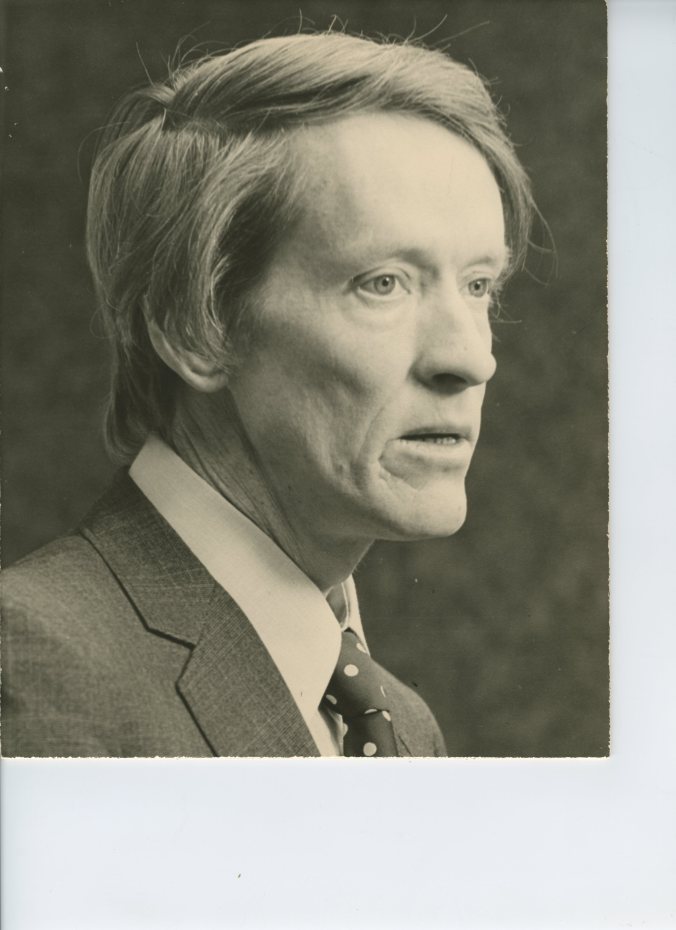
Portrait

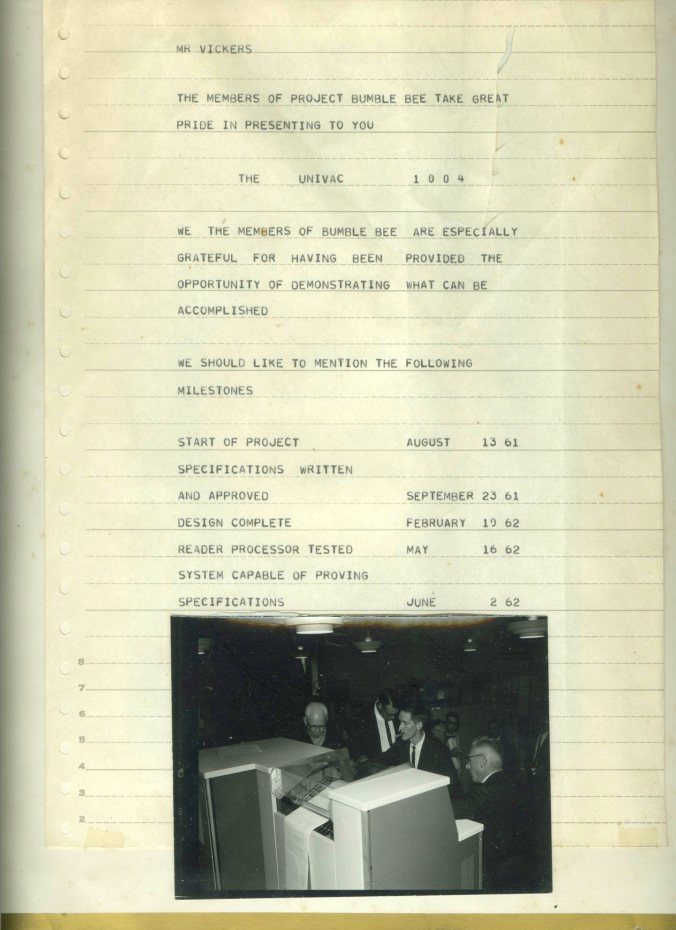
UNIVAC 1004 Introduction
From OCR
THE MEMBERS OF PROJECT BUMBI E BEE TAKE GREAT PRIDE IN PRESENTING TO YOU
THE, UNIVAC 1 0 0
WE THE MEMBERS OF BUMBLE BEE AHE ESPECIALLY GRATEFUL FOR HAVING BEEN PROVIDED THE OPPORTUNITY OF DEMONSTRATING W HAT CAN BE ACCOMPLISHED
SHOULD LIKE TO MENTION THE FOLLOWING
MILESTONES
STARTOFPROJECT SPECIFICATIONS WRITTEN AND APPROVED
DESIGN COMPLETE
READEH PROCESSOR TESTED SYSTEM CAPABLE OF PHOVING SPECIFICATIONS
AUGUST 16 61
SEPTEMBEH 2D 61 F EBHUAR Y 1’3 62 MAY 16 62
JUNE 2 62
Industrial Man of the Year 1970

Talk before Salesmen 12/1/70
From OCR


Gentlemen, it is a pleasure to meet all of you front line troops. You guys that carry the banner. The guys on t he firing line — you are fired up today, you will be more fired up tomorrow and come Saturday you
should be at the point of pitying the competition. But, you had better not, because
heis absolutely ruthless.
His goal in life is to put us out
of business. Now, we are going to help you keep your guard up
We’ ve got a hot product.
It’s got a concept, it fits all t he
buzz’ words, pl us cr eat es a few of its own. It’s got a price
low enough that you don’t have to give trading stamps
it’s got class.
customer is going to be our customer because we do his job
better – because we make him feel confident with us. personal charm can get you an audience with a prospective
customer, your.-s,u:periorsalesmanshipcangethimtoinstall
But that ain’t gonna be what sells it.
a system, but that’s only the preliminaries •
have got to keep it there. All the personal charm and sales-
manship in the world won’t keep equipment installed if it’s not performing for the customer. The one thing worse than not
making a sale, is making one that you~can’t keep made.
are going to provide you some ground rules, some guidelines
and some absolutes that will maximize the odds
instal led equipment installed.
Gentlemen, you are part of a company that is the world leader in real-time data cap@Ore. The world doesn’t know that yet,
but you guys are gonn% tell ~em. And, you’ re gonna tell ~em with more than buzz wor84 — you’ re gonna tell ~em with installed
equipment. And, we’ re going to install equipment by being able to minimize the time, the complexities, the error and
the cost of data cap@ere.
In 1965, after 85 years of accepting the punched card as the only viable method for high volume media conversion, the
world had the opportunity and. the pleasure to try a different approach. Keyboard to compatible tape. It wasn’t a new concept, but it was the first practical implementation of the coneppt. It had some advantages, but only one significant one, it had an internal memory that permitted operators to move at their own speed, and it had disadvantages, it required change. Pressures like the suddenwaneof newS360 systems which pushed delivery times on KP’s to 12 to 16 months and
zip codes that found no vacant columns on, an 80 column card,
not to gentian the shortage of keypunch operators. The
result was fantastic, overnight a small company in Herkimer,N.Y. had created a new industry, and key tape devices were recorded
as a sure road to success~ All one had. to do was look at the number of installed keypunches and the market of key tape machines was unlimited. By early ’68, key tape systems were appearing like toadstools in a spring rain.
By lat e ’69, to the sorrow of many, it was found that all keypunches were not targets for key tapes and that there was a hell of a lot more to media conversion than keyboards magnetic tape and stylized casework. MDS had delivered, maybe 20K units and then found themselves in a holding action against all the “me-too’s”. .
What is it that gives the keypunch such staying power:
2. 3 •
Is the inertia of existing procedures and people skills. The intrinsic advantages of a unit record.
Most importantly, what has been offered as a replace-
ment is recognizable as only an interim step. And for the guy to change, he has to see a path to where he wants
to be. And where does he want to be?
ON LINE
Why
He wants to get rid of the shell game, obviate the shuffling
of cards and t apes and yaper. I
He wants a more timely reporting of changes in his assets.
The more timely his reporting, the faster he turns his inventory,
He wants to eliminate error. To do this, his entry of data must be interactive with his overall data base.
I said, the user wants to get on line, but, he is not ready
today. Our opportunity is to solve today’s problemtoday, with equipment that can al so put the user on l ine. A system
that will permit an orderly evolution fwom free-standing data stations to true on-line operation. That’s our concept
a concept backed by hardware than can do.
I haven’t had sufficient personal conversation with each of you to know and understand why you joined Cogar Corporation.
If it wasn’t to help build. a great company, then you have the wrong motive. Because that’s what it’s all about. This
company was started without a product or a product concept. Products and product concepts are transient, they live but ashort time. Tolive,acompanymusthavevision,conv~qtion and a willingness to compete. It has to have teamwork and leadership. We are going to provide the leadership and we are going to demand that everyone be part of the team.
A lot of people are expecting big things of us. We’ re not going to disappoint them.
Cogar Picks Treasurer, Retains Law Firm 7/18/69

Cogar Advertisement 4/26/70

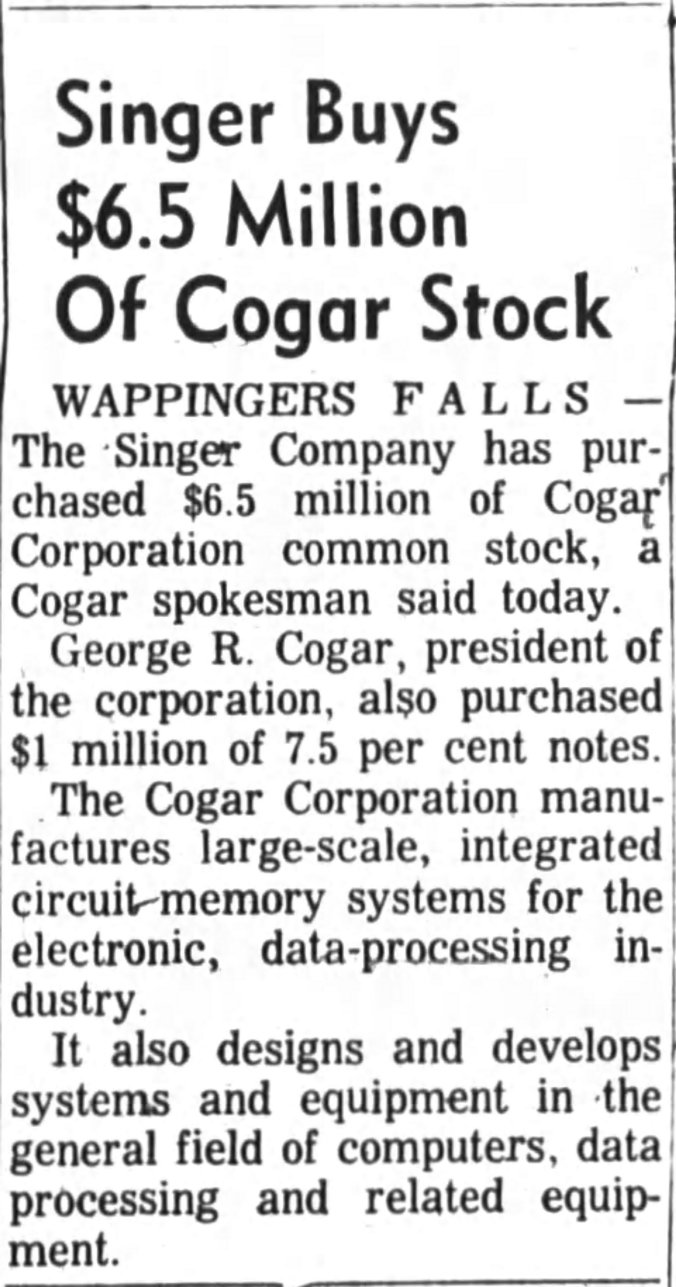
Singer Buys $6.5 Million of Cogar Stock 9/19/1970
Stockholm Talk


Technology and Market’s for the 70’s
From OCR
Page 1
MEMORIES – TECHNOLOGY AND MARKETS FOR THE 70’S
Technical Judgements: Business Decisions
I would preface my comments with the acknowledgement that forecasts of change must weigh carefully the inertia of opinion.
Memories for computers will represent the largest dollar volume for an identifiable product entity in the electronics industry for the 70’s. Early in the decade, monolithic semiconductors will become the dominant main memory technology representing m~re than half of the new sales by 1975 and constituting the majority of in-use main memory before the close of the decade. Read only memories will be an insignificant percentage of the total memory market, due principally to diminishing cost performance advantage, high tooling and support cost and high potential obsolescence.
There are a number of compelling reasons for this to occur – most significantly:
Semiconductor memories offer raw performance in terms of speed and density which is unachievable in other current technologies.
With sub i00 nanosecond memories now in production and new designs having another order of magnitude increase in speed, now in the laboratory, semiconductor memories constitute an exclusive performance class.
Monolithics, being a homogeneous technology, offers the potential of entirely new system architectures. These new architectures will involve parallelism to a degree where today’s definition of memory and processor will seem nonsensical. Hard implementation of memory hierarchy will provide transparency for all levels of programming. Associative memories will become econonkically feasible and it can be expected that associative concepts will be extended to include synoptics.
These new architectures can be expected to contribute substantially toward the solving of the problem of software economics.
Page 2
Being a process-based technology, monolithics have an intrinsic reliability unachievable by technologies involving a piece part assembly base. Further, where the assembly-based technologies have reached, or are rapidly approaching, a plateau in terms of mechanization and will thus have their manufacturing costs directly tied to labor, monolithics have the’potential for significant increases in densities, yields and packaging innovations.
Viewed from a different perspective, one which encompasses overall computer technologies for the 70’s and beyond, monolithics must become the dominant technology if for no other reason than simply that the rate of expenditures within the industry has become so high that we cannot now afford a transitional technology having a known obsolescence. While the inertia of capital investment and engineering and manufacturing skills will be a pressure to extend the life of magnetic technology into the 70’s, the threat of early competitive impact of systems utilizing magnetics will cause monolithics to prevail.
Even the now promising bubble may burst under the competitive pressure of investment in semiconductor technologies with array densitites approaching one million bits per square inch.
To this date, to a great extent, the’management of our industry could be characterized as a tug of war between the engineer and the marketeer. While this was probably a necessary part of the development period of our industry, it is now a luxury we can no longer afford. We have reached a level of business where we can no longer afford to innovate for the hell of it or to market on a basis solely of~ faster, more exotic device. )
Page 3
With the change to principally a process-based technology, one characterized by very high capital investment and a heavy scientific supporting base, many companies must necessarily re-examine their proprietary posture of what and from whom they buy and what and to whom they sell. To those companies who continue to plan their business solely to maximize value added in the p~oduction of hardware, great trauma lies in store.
Where the engineer, the programmer and the marketeer previously made decisions, they will now provide judgement contributing to a more broadly based business decision. Technologies having reached a plateau that is sufficiently broad to discourage the expenditures necessary to attempt the scaling of the next precipice, efforts will now be concentrated onthe refinement of technologies and broadening of the market base.
Submitted by George R. Cogar President Cougar Corporation Herkimer, New York
IEEE – International Computer Group Conference & Exposition Washington, D. C. – June 16-18, 1970.
The 70’s will see a new era of ent~epreneu~ship. Opportunities wi~ increaae in line with the growth of new technologies.
The important ventures of the 70’s, however, will differ significantly from those of the 5O’s and 60’s, in that the ventures of the 7O’s will sta~ on a larger scale.
New technologies are more complex and will require a broader spectrum of disciplines to form a viable organization with sufficient freedom of choice in the planning of it~ development and growth.
The o~ook of people comprising the knowledge industries ~ expanding beyond the perimeter of their own individual specialities.
They are searching for challenges that will also involve the wtilization and management of new idea~ and new technologies.
Knowledge ~ the new wealth, the new ea~, and the people who are making the greatest contribution to tt~ compound growth are going to in6ist on having a proportionate voice in its direction and u~e.


 georgecogar